Research Article | | Peer-Reviewed

Study on the Differences in Salt Tolerance of Platanus Occidentalis Seeds Between Saline and Non-Saline Habitats

Received: 22 September 2026     Accepted: 29 September 2026     Published: 20 October 2026
Views:       Downloads:
Abstract

In this paper, we investigated the differences in salt tolerance physiological characteristics of Platanus occidentalis seeds from Tai'an (non-saline habitat) and Dongying (saline habitat), Shandong Province, China. Ten 18-year-old mother trees from each location were selected as sample sources. Mature fruits were collected for morphological analysis, including measurements of fruit diameter, seed length, thousand-seed weight, and water absorption swelling rate. The tested seeds were evenly placed in Petri dishes and treated with 0 (CK), 0.1%, 0.3%, and 0.5% concentration gradients of sodium chloride (NaCl) and sodium bicarbonate (NaHCO3) solutions, respectively, followed by germination experiments under a light incubator. The results showed that seed length, thousand-seed weight, and fruit diameter of seeds from Tai'an were greater than those from Dongying. Seeds from Tai'an exhibited higher germination rate, germination potential, germination index, vigor index, and lower mean germination time, along with higher seedling fresh weight than those from Dongying under the influence of NaCl and NaHCO3 solutions. The germination rate, germination potential, germination index, and vigor index significantly decreased, except for mean germination time, showing no significant difference; seeding fresh weight and root length also declined significantly with increasing concentrations of NaCl or NaHCO3 solutions. However, NaHCO3 additionally significantly inhibited root average diameter and root tip number compared with NaCl. Overall, the salt tolerance of Platanus occidentalis seeds from Tai'an (non-saline habitat) was significantly higher than that from Dongying (saline habitat), and the inhibitory effect of NaHCO3 was stronger than that of NaCl.

Published in American Journal of Agriculture and Forestry (Volume 14, Issue 5)
DOI 10.11648/j.ajaf.20261405.13
Page(s) 248-260
Creative Commons

This is an Open Access article, distributed under the terms of the Creative Commons Attribution 4.0 International License (http://creativecommons.org/licenses/by/4.0/), which permits unrestricted use, distribution and reproduction in any medium or format, provided the original work is properly cited.

Copyright

Copyright © The Author(s), 2026. Published by Science Publishing Group

Keywords

Platanus Occidentalis, Saline Habitat, Non-saline Habitat, Salt Stress, Seed Germination, NaCl, NaHCO3

1. Introduction
Soil salinization has become one of the research hotspots worldwide. According to statistics, 20% of the world's cultivated land and nearly half of the irrigated land are affected by salt stress , and saline-alkali land in China accounts for approximately 10% of the country's total cultivated land area . The effects of saline-alkali soil on plant seed germination and growth are mainly manifested as osmotic stress, ion toxicity, and high pH stress. Salt stress is usually caused by neutral salts, with NaCl as a representative. Its main hazards are ion toxicity and osmotic imbalance. Studies have shown that low concentrations of NaCl can promote seed germination . As the stress concentration increases, seed germination rate and germination potential decrease to varying degrees , and seedling dry mass, root length, and root surface area are reduced , with significant inhibitory effects on seed germination and seedling growth . In contrast, alkaline stress is caused by alkaline salts, mainly NaHCO3 . In addition to the effects of salt stress, it also causes direct damage induced by high pH, such as reduced cell membrane stability , nutrient imbalance, and metabolic disorders , thereby making the damaging effects of alkaline stress on plant seeds stronger and exerting inhibitory and delayed effects on plant seed germination . Studies have shown that with increasing mass concentration of NaHCO3, seed germination rate and germination potential gradually decrease, and seedlings can tolerate low mass concentrations of NaHCO3 solution , while high concentrations of NaHCO3 treatment significantly inhibit seedling height and root length . Yang et al. showed that the relative germination rate of Echinochloa frumentacea first increased and then decreased with increasing NaHCO3 concentration. Overall, under saline-alkali stress, seed germination potential, germination rate, germination index, and seedling root length and shoot length all showed a decreasing trend , and the inhibitory effect intensified with increasing stress severity . Moreover, the inhibitory effect of NaHCO3 on seed germination and growth was more significant than that of NaCl , and the plant survival rate under NaHCO3 stress was lower than that under NaCl stress at the same concentration . Saline-alkali stress severely restricts plant growth and ecological restoration processes . This makes the screening of salt-tolerant tree species a key issue in saline-alkali land management and sustainable agricultural development.
Differences in seed quality among different provenances can affect seed germination . Seed size is one of the core indicators of seed quality and has an important influence on seed germination and seedling establishment . Larger seeds contain more nutrients and store more energy, which can be used for early seed germination; therefore, they are generally considered beneficial to species reproduction and development , manifesting as higher germination capacity and seedling survival rate . However, under adverse conditions, the germination capacity of seeds of different sizes is not consistent. Some studies have found that under adverse conditions, large seeds have stronger germination capacity than small seeds , and the seedling biomass germinated from large seeds is significantly higher than that from small seeds . However, some studies suggest that the germination advantage of seeds of different sizes is affected by the degree of environmental stress . Meanwhile, other studies have found that small seeds have a greater advantage in germination under adverse conditions , and some studies have also pointed out that under adverse conditions, seed size has no significant effect on germination .
Platanus occidentalis belongs to the family Platanaceae and the genus Platanus, and is distributed in North America, Europe, and western and southeastern Asia. Platanus is known as the "king of street trees in the world" due to its wide distribution, rapid growth, strong adaptability, outstanding pollution resistance, and significant ecological benefits, making it one of the excellent choices for urban greening . The study by Liu et al. showed that because of its large canopy, dense shade, and straight trunk, the transpiration of the Platanus canopy can reduce the surrounding environmental temperature by up to 5.1°C, and the vertical cooling in the human activity layer under the canopy and shade can reach 10°C, effectively improving the local microclimate and playing a great role in mitigating the urban heat island effect. At present, P. occidentalis has been planted on a relatively large scale in urban greening in coastal saline-alkali land, but research on its saline-alkali tolerance is relatively limited. This study investigated the germination process and early seedling characteristics of P. occidentalis seeds from non-saline-alkali land and saline-alkali land under NaCl and NaHCO3 stress, aiming to reveal the differences in seed salt tolerance among different growth environments and provide a basis for the selection of urban greening tree species in saline-alkali land.
2. Materials and Methods
2.1. Seed Collection
Seeds of P. occidentalis from non-saline habitat were collected in April 2024 on the east side of the road north of the intersection of Panhe Street and Wenquan Road in Tai'an, while seeds of P. occidentalis from saline habitat were collected in March 2024 in Hekou District, Dongying. The P. occidentalis trees in the Tai'an area were approximately 18 years old, with a mean diameter at breast height (DBH) of 34.1 cm and a mean tree height of 10 m, whereas those in the Dongying area were approximately 18 years old, with a mean DBH of 26 cm and a mean tree height of 9 m. Ten mother trees were randomly selected from each location, and 5-10 fruits were collected from each mother tree. The fruits were harvested using a high-branch pruner and brought back to the laboratory.
2.2. Experimental Design
Twenty fruits were randomly selected from the fruits collected at each of the two locations, and their diameters were measured with a vernier caliper. The mature fruit balls were sealed in ziplock bags and subjected to mechanical crushing, followed by friction separation using a stainless steel sieve (with a pore size gradient of 2.0 mm). Physical separation of the fluff and needle-like seeds was achieved through sieving, and secondary separation of seed hairs was accomplished by wind. Finally, after morphological screening, 3,000 pure seed samples meeting the experimental requirements were obtained from each of the two locations. Thirty seeds were randomly selected from the seeds of each location to measure their length. Considering the time consumption of seed acquisition, the 100-seed method was adopted in this study to determine the 1000-seed weight. Additionally, 500 seeds from each location were divided into five groups and weighed. The seeds were then soaked in warm water for 24 h, removed, and blotted dry to measure their weight. The imbibition rate of seeds from the two locations was calculated using the imbibition rate formula.
In this experiment, NaCl and NaHCO3 solutions were used to simulate salt stress and alkaline stress, respectively, with solution concentration gradients of 0 (CK), 0.1%, 0.3%, and 0.5%. According to the rules for forest tree seed testing, sterilized and oven-dried Petri dishes with a diameter of 90 mm were used, and two layers of filter paper were placed inside to prepare the germination bed. The prepared salt solutions at each concentration gradient were added to the Petri dishes to fully moisten the filter paper, and the seeds were then evenly placed on the filter paper. Before sowing, the seeds needed to be fully treated. A 3% KMnO4 solution was prepared, and the seeds were immersed in groups for disinfection for 30 min, followed by rinsing with deionized water until colorless. Then, according to the GB 2772-1999 standard, the seeds were soaked in deionized water at 50°C for 24 h for germination acceleration before sowing. Fifty seeds were evenly placed in each Petri dish. The seeds from each location treated with salt solution and alkaline solution were each set as one group, with five replicates per group, and four different concentration treatments were included in each replicate, totaling 80 Petri dishes. The dishes were then placed in an illuminated incubator set at 25°C for a total of 9 days. A quantified amount of deionized water was supplemented daily. According to the rules for forest tree seed testing, the number of germinated seeds was recorded daily, and moldy and rotten P. occidentalis seeds and seed coats were promptly removed. The observed indicators included germination parameters (germination potential and germination rate), and the germination index, vigor index, and mean germination time were calculated according to the formulas. The experiment was terminated 9 days after the start. In each Petri dish, seedlings with the most average growth were randomly selected to measure seedling fresh weight, root length, root surface area, root average diameter, and root tip number.
Germination rate (GR) = (number of germinated seeds / total number of tested seeds) × 100%
Germination potential (GP) = (number of germinated seeds on day 4 / total number of tested seeds) × 100%
Germination index (GI) = ∑(Gt/Dt), where: Gt is the number of net germination on each day; Dt is the corresponding germination day.
Vigor index (VI) = S × GI, where: S is the seedling fresh weight; GI is the germination index.
Mean germination time (MGT) = (∑D×n)/Σn, where: n is the number of normal germinated seeds on each corresponding day; D is the number of days from seed placement.
2.3. Data Processing and Analysis
Data were organized and statistically analyzed using Excel with SPSS 17.0 software. Two-factor analysis of variance (ANOVA) was performed on the germination indicators and seedling indicators. If the differences were significant, multiple comparisons were then performed using the least significant difference (LSD) method, and the level of significant difference test for analysis was P < 0.05.
3. Results and Analysis
3.1. Seed Characteristics of P. Occidentalis from Saline and Non-saline Habitat
Table 1. Seed characteristics of P. occidentalis under different habitats.

Habitat

Fruit diameter/cm

Seed length/cm

Thousand-seed weight/g

Imbibition rate (%)

Saline habitat

3.17±0.45 a

1.17±0.11 a

3.33±0.07 a

87.60±4.72 a

Non-saline habitat

3.87±0.27 b

1.23±0.08 b

4.47±0.12 b

85.60±1.34 a

Note: Different lowercase letters in the same column indicate significant differences (P<0.05).
Habitat had highly significant effects on fruit diameter and seed length, significant effects on 1000-seed weight, but no significant effects on imbibition rate. The fruit diameter, seed length, and 1000-seed weight of P. occidentalis from non-saline habitat were all higher than those from saline habitat (Table 1). These differences in the indicators further indicate that salt stress in saline habitat inhibited the normal development of seeds, resulting in reduced morphological size, which decreased the organic substances stored in the seeds and may affect the energy supply during early germination.
3.2. Effects of Habitat and NaCl Stress on Seed Germination and Seedling Growth of P. Occidentalis
3.2.1. Seed Germination
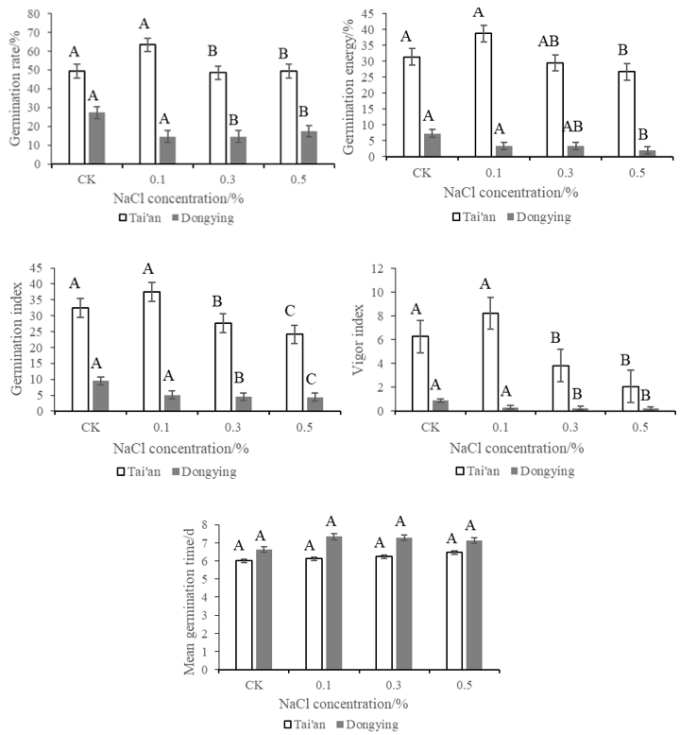
Habitat had highly significant effects on the germination rate, germination potential, germination index, vigor index, and mean germination time of P. occidentalis seeds (Table 2). Under NaCl stress, the germination rate, germination potential, germination index, and vigor index of seeds from Tai'an were all significantly higher than those from Dongying, while the mean germination time was significantly lower than that of seeds from Dongying (Figure 1).
NaCl concentration significantly affected germination potential and had highly significant effects on germination rate, germination index, and vigor index, but had no significant effect on mean germination time (Table 2). With increasing NaCl concentration, seed germination rate, germination potential, germination index, and vigor index all gradually decreased (Figure 1). Among the different NaCl concentrations, the difference in germination rate between CK and 0.1 was not significant (P > 0.05), but both were significantly higher than those at 0.3 and 0.5 (P < 0.05), while the difference between 0.3 and 0.5 was not significant (P > 0.05); the differences in germination potential among CK, 0.1, and 0.3 were not significant (P > 0.05), while CK and 0.1 were significantly higher than 0.5 (P < 0.05), and the difference between 0.3 and 0.5 was not significant (P > 0.05); the difference in germination index between CK and 0.1 was not significant (P > 0.05), but both were significantly higher than that at 0.3 (P < 0.05), with 0.5 being the lowest (P < 0.05); the difference in vigor index between CK and 0.1 was not significant (P > 0.05), but both were significantly higher than those at 0.3 and 0.5 (P < 0.05), and the difference between 0.3 and 0.5 was not significant (P > 0.05).
The interaction between habitat and NaCl concentration had highly significant effects on germination rate, germination index, and vigor index, but had no significant effects on germination potential or mean germination time (Table 2). With increasing NaCl concentration, the seeds from the Tai'an area showed a trend of first increasing and then decreasing in these three indicators, whereas those from the Dongying area decreased gradually (Figure 1).
Table 2. Two-way ANOVA of seed germination and seedling traits of P. occidentalis from different habitats under different NaCl concentrations.

Parameter

Habitat

NaCl concentration

Habitat×NaCl concentration

F-value

P-value

F-value

P-value

F-value

P-value

Germination rate

620.298

<0.001

7.307

0.002

15.613

<0.001

Germination energy

318.196

<0.001

3.626

0.034

2.833

0.069

Germination index

545.909

<0.001

11.063

<0.001

6.617

0.004

Vigor index

133.396

<0.001

12.111

<0.001

10.062

<0.001

Mean germination time

64.486

<0.001

3.972

0.26

1.779

0.189

Seedling fresh weight

1153.943

<0.01

17.731

<0.01

12.678

<0.01

Root tip number

0.471

0.502

1.861

0.174

0.161

0.921

Root length

4.464

0.050

11.992

<0.001

2.118

0.136

Root average diameter

1.381

0.256

1.444

0.256

2.484

0.096

Root surface area

3.697

0.071

3.789

0.03

1.286

0.311

Figure 1. Effects of different NaCl concentrations on seed germination of P. occidentalis from different habitats.
Different uppercase letters indicate significant differences among treatments within the same habitat (P < 0.05). The same applies below.
3.2.2. Seedling Growth
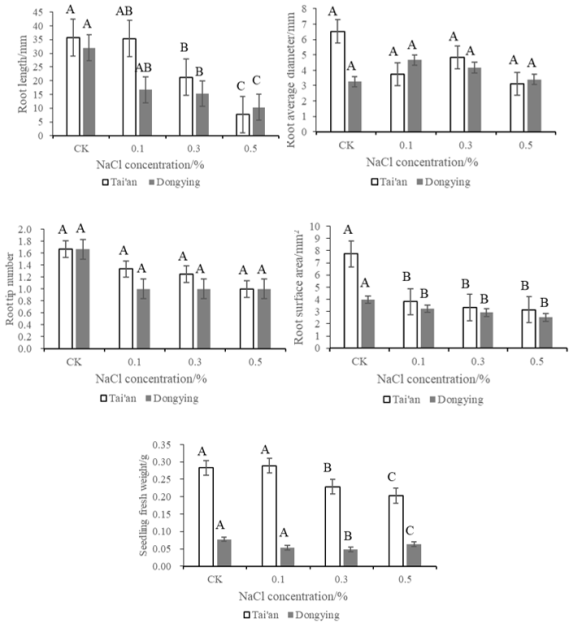
As shown in Table 2, habitat had highly significant effects on seedling fresh weight, but had no significant effects on root length, root average diameter, root surface area, or root tip number. NaCl concentration had highly significant effects on seedling fresh weight and root length, significant effects on root surface area, but no significant effects on root average diameter or root tip number. The interaction between habitat and NaCl stress had highly significant effects on seedling fresh weight, but had no significant effects on root length, root surface area, root average diameter, or root tip number.
As shown in Figure 2, compared with the Dongying area, seedlings developed from seeds from the Tai'an area had higher seedling fresh weight. The general trends of changes in fresh weight, root length, and root surface area of P. occidentalis seedlings from the Tai'an area all decreased with increasing salt concentration. Among the different NaCl concentrations, the difference in root length between CK and 0.1 was not significant (P > 0.05), while CK was significantly greater than 0.3 (P < 0.05); the difference between 0.1 and 0.3 was not significant (P > 0.05), and 0.5 was the lowest (P < 0.05). The root surface area was the largest in the CK group (P < 0.05), and the differences among 0.1, 0.3, and 0.5 were not significant (P > 0.05). The difference in seedling fresh weight between CK and 0.1 was not significant (P > 0.05), but both were significantly greater than that at 0.3 (P < 0.05), with 0.5 being the lowest (P < 0.05). With increasing NaCl concentration, the difference in seedling fresh weight between the Tai'an and Dongying areas gradually decreased.
Figure 2. Effects of different NaCl concentrations on seedling growth of P. occidentalis from different habitats.
3.3. Effects of Habitat and NaHCO3 Stress on Seed Germination and Seedling Growth of P. Occidentalis
3.3.1. Seed Germination
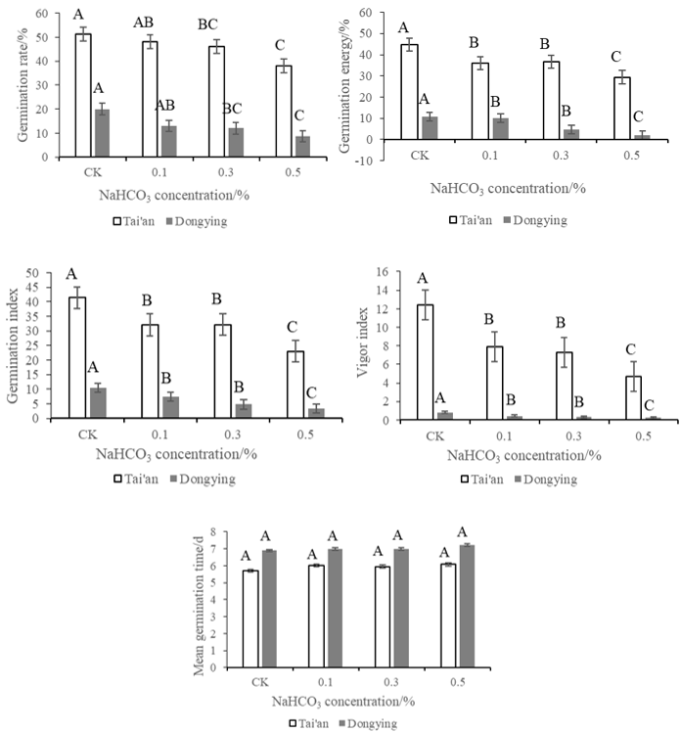
Habitat had highly significant effects on the germination rate, germination potential, germination index, vigor index, and mean germination time of P. occidentalis seeds (Table 3). The germination rate, germination potential, germination index, and vigor index of seeds from Tai'an were all significantly higher than those of seeds from Dongying, while the mean germination time of seeds from Tai'an was significantly lower than that of seeds from Dongying (Figure 3).
NaHCO3 concentration had highly significant effects on germination rate, germination potential, germination index, and vigor index, but had no significant effect on mean germination time (Table 3). With increasing NaHCO3 concentration, the values of germination rate, germination potential, germination index, and vigor index all gradually decreased (Figure 3). Among the different NaHCO3 concentrations, the difference in germination rate between CK and 0.1 was not significant (P > 0.05), while CK was significantly greater than 0.3 (P < 0.05); the difference between 0.1 and 0.3 was not significant (P > 0.05); CK and 0.1 were significantly greater than 0.5 (P < 0.05), and the difference between 0.3 and 0.5 was not significant (P > 0.05). For germination potential, germination index, and vigor index, CK was significantly greater than 0.1 and 0.3 (P < 0.05), with no significant difference between 0.1 and 0.3 (P > 0.05), and 0.5 was the lowest (P < 0.05).
The interaction between habitat and NaHCO3 concentration had highly significant effects on germination index and vigor index, but had no significant effects on germination rate, germination potential, or mean germination time (Table 3). Overall, with increasing NaHCO3 concentration, the differences in germination index and vigor index between seeds from the Tai'an area and those from the Dongying area gradually decreased (Figure 3).
Figure 3. Effects of different NaHCO3 concentrations on seed germination of P. occidentalis from different habitats.
Table 3. Two-way ANOVA of seed germination and seedling traits of P. occidentalis from different habitats under different NaHCO3 concentrations.

Parameter

Habitat

NaHCO3 concentration

Habitat×NaHCO3 concentration

F-value

P-value

F-value

P-value

F-value

P-value

Germination rate

289.175

<0.001

7.942

0.002

0.450

0.721

Germination energy

530.229

<0.001

16.573

<0.001

2.103

0.146

Germination index

879.423

<0.001

40.784

<0.001

8.546

0.002

Vigor index

703.353

<0.001

41.094

<0.001

29.801

<0.001

Mean germination time

49.709

<0.001

1.011

0.417

0.097

0.96

Seedling fresh weight

96.218

<0.001

20.664

<0.001

1.723

0.208

Root tip number

0.636

0.438

4.532

0.02

0.521

0.675

Root length

3.931

0.067

23.804

<0.001

1.473

0.265

Root average diameter

9.551

0.008

13.988

<0.001

3.6

0.041

Root surface area

14.342

0.002

3.058

0.063

7.195

0.004

3.3.2. Seedling Growth
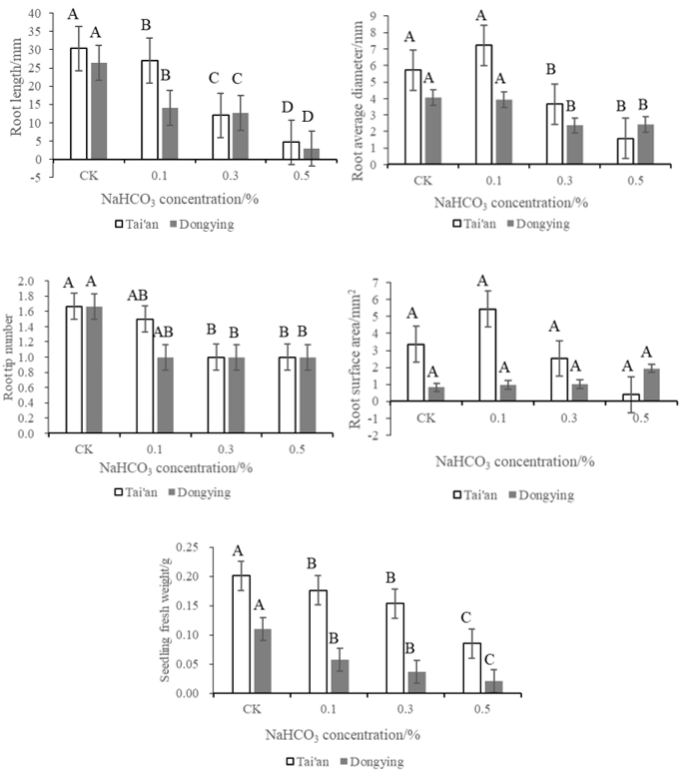
As shown in Table 3, habitat had highly significant effects on seedling fresh weight, root average diameter, and root surface area, but had no significant effects on root tip number or root length. NaHCO3 stress had highly significant effects on seedling fresh weight, root length, and root average diameter, significantly affected root tip number, but had no significant effect on root surface area. The interaction between habitat and NaHCO3 concentration had highly significant effects on root surface area and significant effects on root average diameter, but had no significant effects on seedling fresh weight, root tip number, or root length.
As shown in Figure 4, compared with those from the Dongying area, seedlings developed from seeds from the Tai'an area had higher seedling fresh weight and root surface area. With increasing NaHCO3 concentration, seedling fresh weight, root length, root average diameter, and root tip number all gradually decreased. Among the different NaHCO3 concentrations, the difference in root average diameter between CK and 0.1 was not significant (P > 0.05), while both were significantly greater than those at 0.3 and 0.5 (P < 0.05), and the difference between 0.3 and 0.5 was not significant (P > 0.05); the difference in root tip number between CK and 0.1 was not significant (P > 0.05), while CK was significantly greater than 0.3 and 0.5 (P < 0.05), and the differences among 0.1, 0.3, and 0.5 were not significant (P > 0.05); seedling fresh weight in the CK group was significantly greater than that at 0.1 and 0.3 (P < 0.05), the difference in seedling fresh weight between 0.1 and 0.3 was not significant (P > 0.05), and 0.5 was the lowest (P < 0.05); for root length, CK > 0.1 > 0.3 > 0.5 (P < 0.05). The differences in root surface area and root average diameter between the Tai'an and Dongying areas became smaller with increasing NaHCO3 concentration.
Figure 4. Effects of different NaHCO3 concentrations on seedling growth of P. occidentalis from different habitats.
4. Discussion
4.1. Effects of Salt Stress on Seed Germination and Seedling Growth
The seed germination stage and seedling stage are the periods most sensitive to environmental stress in the plant life cycle . In this study, NaCl stress significantly inhibited the seed germination and early seedling growth of P. occidentalis. During the germination stage, an increase in NaCl concentration significantly reduced the germination rate and germination potential of seeds, and highly significantly impaired the overall speed and vigor performance of seed germination. Meanwhile, NaCl stress generally prolonged the time required for seeds to progress from water imbibition to germination, slowing down the germination process, which is consistent with the findings of Tong et al. and Xu et al. . During the seedling growth stage, the negative effects of NaCl stress were equally significant: first, it highly significantly inhibited the accumulation of seedling biomass , reducing fresh weight; at the same time, the root elongation capacity of seedlings was highly significantly inhibited , and the total area of root-soil contact was also significantly reduced, which greatly limited the ability of seedlings to absorb water and nutrients. Studies have shown that when plants are subjected to NaCl stress, the root system immediately perceives changes in the external environment , thereby slowing down the transport of water and nutrients, and consequently inhibiting biomass accumulation . Lin et al. showed that with increasing degrees of NaCl stress, the germination rate, germination index, and vigor index of Robinia pseudoacacia seeds were significantly reduced, while the mean germination time was significantly increased; seedling water content, biomass, root length, root surface area, specific root length, and specific root surface area were significantly reduced, and NaCl stress significantly inhibited seed germination, seedling growth, and root development of Robinia pseudoacacia. Taken together, NaCl salt stress, mainly through the dual effects of osmotic stress and ion toxicity, significantly inhibits seed germination and vigor, and severely suppresses early seedling biomass accumulation and root development, thus becoming a key limiting factor for its propagation, cultivation, and natural survival in saline-alkali soils.
This study found that NaHCO3 stress significantly inhibited the seed germination and seedling growth of P. occidentalis. During the seed germination stage, NaHCO3 stress exerted highly significant inhibitory effects on the germination rate, germination potential, germination index, and vigor index, while its effect on the mean germination time was not significant. Qiao's study on naked oats also showed that the seed germination rate gradually decreased with increasing NaHCO3 concentration. In this study, during the seedling stage of P. occidentalis, the inhibition was manifested in multiple dimensions: fresh weight, root length, and average root diameter were highly significantly reduced, and the number of root tips was significantly decreased, but the change in root surface area was not significant. Pei et al. also found that the seedling fresh weight and radicle length of buckwheat decreased with increasing NaHCO3 solution concentration. Cai et al.'s study on rapeseed found that the root length of Huayouza 62 first increased and then decreased with increasing NaHCO3 concentration, whereas the root length of Xiangyou 15 gradually decreased with increasing NaHCO3 concentration. Under NaHCO3 stress, osmotic stress and ion toxicity act synergistically, jointly reducing germination potential, hindering biomass accumulation, and impairing root development, ultimately restricting the growth of P. occidentalis in saline-alkali environments.
By comparing the data from the two treatments, it can be seen that both NaCl and NaHCO3 stress had substantial effects on the seeds of P. occidentalis. Both hindered seed germination and seedling growth through the dual effects of osmotic stress and ion toxicity, exerting varying degrees of influence on each index, with the effects being particularly pronounced under high-concentration stress. However, the two treatments also affected different indices of seed germination and seedling growth of P. occidentalis to varying degrees. During the seed germination stage, NaHCO3 had highly significant effects on the germination rate, germination potential, germination index, and vigor index of P. occidentalis seeds, whereas NaCl had highly significant effects only on the germination index and vigor index, and significant effects on the germination rate and germination potential, indicating that the inhibitory effect of NaHCO3 on seed germination was greater than that of NaCl. This is consistent with the findings of Wang et al. , Pan et al. , and Lei et al. , who reported that plant materials are more sensitive to NaHCO3 alkaline stress than to NaCl salt stress at corresponding concentrations. This may be because, in addition to the effects of Na⁺ ion toxicity and osmotic stress on the seed germination of P. occidentalis, the high pH stress induced by alkaline salts causes cell membrane damage , reduces plant root activity and nutrient uptake rates , and decreases the availability of mineral elements , thereby causing further inhibition and damage to seed germination . During the seedling growth stage, both treatments had highly significant effects on seedling fresh weight and root length, indicating that both greatly affected seedling biomass accumulation and root elongation capacity. The difference is that NaHCO3 also had significant effects on the average root diameter and number of root tips of seedlings, whereas NaCl did not significantly affect these two parameters but did significantly affect root surface area, suggesting that the two treatments have different modes of influence on root growth.
4.2. Effects of Habitat on Seed Germination and Seedling Growth
A large number of studies have shown that seed size determines seed quality and is related to the nutrients contained in seeds . In this study, the fruit diameter, seed length, and thousand-grain weight of P. occidentalis from non-saline habitat were all significantly higher than those from saline habitat. Under salt stress conditions, the germination rate, germination potential, germination index, vigor index, and seedling fresh weight of seeds from non-saline habitat in Tai'an were all significantly higher than those of seeds from saline habitat in Dongying, and seeds from saline habitat had a longer mean germination time than those from non-saline habitat. This is consistent with the findings of Wu et al. , in which the germination rate, germination potential, germination index, and vigor index of Fraxinus velutina seeds from non-saline habitat were significantly higher than those of seeds from saline habitat. A significant advantage of large seeds in seedling biomass has also been found in Pinus thunbergii and Quercus acutissima . Large seeds are rich in nutrients and have higher germination rates, growth rates, and survival competitiveness ; under adverse conditions, large seeds have stronger resistance and adaptability than small seeds. Studies have shown that the vigor index of mulberry seeds from non-saline habitat is higher than that of seeds from saline habitat, which is closely related to their higher thousand-grain weight compared with seeds from saline habitat . When plants grow in saline habitat for a long time, maintaining their salt tolerance and continued growth in a saline medium requires the consumption of large amounts of nutrients for physiological regulation and adaptation to the saline-alkali environment, thereby limiting their growth and reducing nutrient allocation to seeds . Since the early growth of seedlings mainly depends on the nutrient substances contained in the seeds , the fresh weight of seedlings from saline habitat is smaller than that of seedlings from non-saline habitat. The strong salt tolerance of seeds from non-saline habitat is related to the fact that their growth is not affected by salt stress. However, Liu et al. showed that seeds of Ulmus pumila from saline habitat had a higher germination index and a lower mean germination time than those from non-saline habitat, which is inconsistent with the results of this study. This may be related to the strong salt tolerance of Ulmus pumila, which, after many years of reproduction and natural selection, has adapted to the saline-alkali environment and developed genetic variation with a certain degree of salt tolerance.
5. Conclusion
This study found that seeds from non-saline habitat in Tai'an had a higher thousand-grain weight, as well as higher germination capacity and early seedling biomass, than seeds from saline habitat in Dongying. This indicates that the seed quality from non-saline habitat is superior to that from saline habitat, and the seeds also possess stronger salt tolerance. Both NaCl and NaHCO3 stress significantly inhibited the seed germination and early seedling growth of P. occidentalis, and the effects decreased significantly with increasing salt concentration, and the inhibitory effects intensified with increasing concentration, indicating that this tree species is sensitive to salt stress. Overall, NaHCO3 exhibited a stronger inhibitory effect on the seed germination of P. occidentalis than NaCl.
Abbreviations

GR

Germination Rate

GP

Germination Potential

GI

Germination Index

VI

Vigor Index

MGT

Mean Germination Time

ANOVA

Analysis of Variance

LSD

Least Significant Difference

Author Contributions
Lin Qi: Writing – original draft
Yong Zhao: Writing –original draft
Ziliang Zhang: Methodology
Haiyan Liu: Formal Analysis
Conflicts of Interest
The authors declare no conflicts of interest.
References
[1] Yang G, Tang L, Li S, Zhao C. Study on the difference of seed germination and salt tolerance of four Brassica napus varieties in Xizang. Seed, 2024, 43(2): 104-110.
[2] Hu H, Cui L, Wang J, Wang Z, Du J. Salt tolerance of seeds of different Elymus sibiricus lines at germination stage. Journal of Arid Land Resources and Environment, 2022, 36(11): 119-126.
[3] Liu Z, Liu C, Zheng K, Zhuang J. Effects of different sodium salt stress on seed germination and seedling growth of Robinia pseudoacacia. Seed, 2022, 41(10): 65-72.
[4] Lian J, Ao Y, Lu T, Yan B. The effects of salt stress on four Xanthoceras sorbifolium provenances and their salt tolerance comprehensive evaluation. Journal of Northeast Forestry University, 2024, 52(6): 20-26.
[5] Huang H, Fu J, Cao B, Zhao W, Hao M, Mao P, Wang T, Hao Y, Zhang X, Tan H. Effects of salt stress and temperature on seed germination and seedling growth of Morus alba. Journal of Southwest Forestry University (Natural Sciences Edition), 2021, 41(2): 30-37.
[6] Jia F, Li l, Tan L, Chen Y, Song X, Li J, Liang M. Responses of seed germination and seedling growth of Celosia argentea to various stresses. Journal of Southwest Forestry University (Natural Sciences Edition), 2025, 45(4): 11-17.
[7] Yu Z, Yan H, Zhang H, Yang X. Effect of different salt stresses on seed germination and seedling physiological characteristics of Gleditsia sinensis. Journal of Northeast Agricultural University, 2020, 51(10): 28-35.
[8] Zheng X, Li A, Wu C, Nie R, Ji X, Wang R, Dong M, Zhang J. Physiological responses of red kernel walnut seedlings to saline-alkali compound stress. Journal of Nanjing Forestry University (Natural Sciences Edition), 2026, 50(3): 14-26.
[9] Wang T, Zhang Z, Liu M, Wang Y, An C, Gong L. Differential effects of saline and alkaline stress on water uptake and germination of alfalfa seeds. Pratacultural Science, 2025, 42(12): 3108-3119.
[10] Zhao W, Li A, Zhu Y, Li Y, Ye Z, Ren H. Effects of γ-aminobutyric acid and chlorinated hemin composite coating on seed germination and seedling growth of Psathyrostachys juncea under drought and salt stresses. Chinese Journal of Applied Ecology, 2026, 37(1): 82-92.
[11] Zhang T, Sheng J, Wang R, Li H, Yang Y. Effects of salt-alkali stress and temperature on seed germination of Artemisia scoparia. Acta Agrestia Sinica, 2019, 27(3): 581-588.
[12] Qi W, Li Y, Ma H, Wu H. Intraspecific variation of seed germination characteristics of Leymus chinensis under salt stress and its influencing factors. Acta Ecologica Sinica, 2025, 45(11): 5481-5496.
[13] Qiao F. Effects of osmoregulation substances and antioxidant enzyme activities of Avena nuda L. seedlings treated with NaHCO3. Journal of Gansu Agricultural University, 2022, 57(5): 53-60.
[14] Meng C, Lu X, Wang J, Wei Y, Zhang C, Li Y, Xu Z. Effects of different salt stresses on triticale seed germination. Acta Prataculturae Sinica, 2023, 32(12): 171-180.
[15] Yang Y, Mao G, Ma D, Zhang F, Xu X. Germination characteristics of four forage seeds under different concentrations of NaCl or NaHCO3 stress. Acta Agrestia Sinica, 2022, 30(3): 637-645.
[16] Ji X, Peng M, Lei C, Jiang L. Effects of different types of salinity on seed germination and young seedling growth of Halostachys capsica. Journal of Northwest Forestry University, 2022, 37(3): 114-119.
[17] Yang X, Zhang Y, Zhang S, Zhang W. Effects of salt and alkali stress on seed germination and physiological characteristics of wheat germplasm materials. Chinese Journal of Ecology, 2026, 45(5): 1533-1543.
[18] Zhang Y, Wang J, Wu W, Liu G, Gao Q, Yang Y, Jia S. Effects of saline-alkali stress on the seed germination and physiological characteristics of corn poppy seedlings. Pratacultural Science, 2025, 42(9): 2262-2274.
[19] Guo W, Wang G, Gou Q. Effects of sodium salt stress on the growth and biomass allocation of Chenopodiaceae annuals. Acta Ecologica Sinica, 2021, 41(16): 6633-6643.
[20] Zhu J, Cui Z, Wu C, Deng C, Chen J, Zhang H. Research advances and prospect of saline and alkali land greening in China. World Forestry Research, 2018, 31(4): 70-75.
[21] Yuan Q, Bai Z, Yao F, Li Q, Wang Z, Yao G, Li G. Effects of fertilization dosage on seedling quality of different provenances Quercus variabilis. Journal of Southwest Forestry University (Natural Sciences Edition), 2023, 43(2): 17-25.
[22] Zhang N, Wu Y, Wu Z. Study on seed characteristics and germination of Indigofera stachyodes from different provenances. Seed, 2022, 41(1): 7-13, 43.
[23] Li S, Zou N, Zhang D, Yuan S, Li Z, Gan Y, Zeng Y, Wu Z. Study on seed germination and seedling growth characteristics of Rhodoleia championii from different provenances. Journal of Southwest Forestry University (Natural Sciences Edition), 2024, 44(6): 29-36.
[24] Mao P, Guo L, Gao Y, Qi L, Cao B. Effects of seed size and sand burial on germination and early growth of seedlings for coastal Pinus thunbergii Parl. in the northern Shandong Peninsula, China [J]. Forests, 2019, 10(3): 281.
[25] Mao P, Kan X, Pang Y, Ni R, Cao B, Wang K, Zhang J, Tan C, Geng Y, Cao X, Wang S, Gao P, Dong J. Effects of forest gap and seed size on germination and early seedling growth in Quercus acutissima plantation in Mount Tai, China [J]. Forests, 2022, 13(7): 1025.
[26] Guo Y, Liu H, Yu H, Zhao J, Hao Y. Effects of seed size and drought stress on growth of Xanthoceras sorbifolia seedlings. Journal of Northwest A&F University (Natural Sciences Edition), 2016, 44(8): 143-147.
[27] Fu J, Zhang C, Wang X, Liu Z, Qin Y, Zhang M, Zhao J, Zhao S, Cao B, Mao P. Effects of water stress and seed size on seed germination of Platycladus orientalis. Seed, 2020, 39(2): 50-57.
[28] Zhu S, Wang F, Liu Y, Sun T, Chai C, Zhang J, Zhang H. Effects of soil moisture and seed size on the germination, sprouting and sapling growth of Haloxylon ammodendron. Journal of Northwest Forestry University, 2021, 36(6): 16-21.
[29] Zhao L, Mo B, Wang P, Zhang Y, Long Z. Relationship of Sophora davidii seed size to germination, dormancy, and mortality under water stress [J]. South African Journal of Botany, 2015, 99: 12-16.
[30] Wang H, Wang P, Zhao G, Sun Q, Long Z, Zhang Y. Seed size and germination strategy of Sophora davidii under drought stress. Acta Ecologica Sinica, 2016, 36(2): 335-341.
[31] Ameixa O, Marques B, Fernandes V, Soares A, Calado R, Lilleb A. Dimorphic seeds of Salicornia ramosissima display contrasting germination responses under different salinities [J]. Ecological engineering: The Journal of Ecotechnology, 2016, 87: 120-123.
[32] Pang H, Wang J, Ao Y, Mu C. Effectsof seed size and bract of Ceratoides arborescens on germination and seedling growth under drought stress. Chinese Journal of Applied Ecology, 2021, 32(2): 399-405.
[33] Wang H, Hu Y, Yan H, Wu R, Bao Z. The effect of the tree structure of Platanus on the microclimate and pedestrian thermal comfort in urban street. Chinese Landscape Architecture, 2025, 41(4): 123-129.
[34] Liu B, Peng X. Measurement and analysis of vertical cooling effect on Platanus acerifolia street tree in summer. Journal of Chinese Urban Forestry, 2018, 16(5): 11-16.
[35] Wang H, Sun Y, Li S, Jia S, Yang K, Wei K, Ma C, Wang X. Effects of saline-alkali stress on seed germination, seedling growth and physiological characteristics of Cyperus esculentus. Acta Agrestia Sinica, 2026, 34(7): 2540-2552.
[36] Tong Y, Guo S, Wang X, Ma Y, Yang J, Yu D, Li S. Effects of exogenous nicotinamide supplementation on alfalfa seed germination and seedling saline-alkali tolerance. Acta Ecologica Sinica, 2026, 46(15): 1-18.
[37] Xu R, Gao J, Ren B, Guan S, Ge T, Wang N. Effects of temperature on seed germination and seedling growth of two Astragalus species under drought and salt stresses. Chinese Journal of Ecology, 2020, 39(9): 2930-2934.
[38] Qi L, Guo L, Liu Y, Cao B, Mao P, Li Z. Dynamic responses of non-structural carbohydrates in Robinia pseudoacacia seedlings to NaCl stress. Scientia Silvae Sinicae, 2022, 58(1): 32-42.
[39] Shao Q, Wang W, Wang J, Yi M, Zhang D, Xie Q. Effects of mixed saline-alkaline stress on seed germination and physiological indices of Medicago sativa. Seed, 2026, 45(6): 97-104.
[40] You J, Wang W, Lu J, Jia P, Miao J, Yang Y. Effects of salinity on seed germination and seedling growth in halophyte Limonium aureum (L.) Hill. Acta Ecologica Sinica, 2012, 32(12): 3825-3833.
[41] Lu C, Liu Y, Wu J, Yuan Z, Hu R, Zhang S, Wang X, Cao C, Zhang B, Lu H. Response of different potato cultivar seedlings to NaHCO3 stress and the screening of indicators for anti-NaHCO3 stress. Jounal of Plant Nutrition and Fertilizers, 2024, 30(4): 745-756.
[42] Lin Q, Zhu X, Mao P, Zhu L, Guo L, Li Z, Cao B, Hao Y, Tan H, Hong P, Lu X. Effects of NaCl and PEG stresses on germination and seedling growth of Robinia pseudoacacia seeds with different sizes. Scientia Silvae Sinicae, 2022, 58(2): 100-112.
[43] Pei Y, Qi X, Liu F, Wang L, Nie J, Yang X, Zhang W, Mao J. Effect of NaCl and NaHCO3 stress on the seeds germination of Fagopyrum esculentum. Seed, 2016, 35(11): 13-18.
[44] Cai X, Sun L, Cao X, Zhang F. Effects of NaHCO3 stress on photosynthetic characteristics and sodium and potassium ions of oilseed rape seedlings with different salt tolerances. Pratacultural Science, 2025, 42(9): 2275-2285.
[45] Wang G, Guo W, Gou Q. Effects of sodium salt stress on seed germination of typical annuals in a desert-oasis ecotone of Hexi Corridor, China. Chinese Journal of Applied Ecology, 2020, 31(6): 1941-1947.
[46] Pan P, Ni Q, Ma R, Yang Y, Ma Y. Effects of different salt treatments on seed germination and seedling growth of Lycium ruthenicum Murr. Acta Agrestia Sinica, 2021, 29(2): 342-348.
[47] Lei C, Ji X, Peng M, Jiang L. Effects of sodium salinity stress types on the germination of Kalidium foliatum seeds and its young seedling growth. Arid Zone Research, 2021, 38(5): 1436-1441.
[48] Gui J, Zhao Y, Liu W, Wang B, Wang X, Chen L, Wei X. Effects of exogenous 2, 4-epibrassinolide on seed germination and seedling growth of quinoa under saline-alkali stress. Chinese Journal of Grassland, 2025, 47(10): 34-43.
[49] Xu J, Yang J, Xu Z, Zhao D, Hu X. Exogenous spermine-induced expression of SlSPMS gene improves salinity-alkalinity stress tolerance by regulating the antioxidant enzyme system and ion homeostasis in tomato [J]. Plant Physiology and Biochemistry, 2020, 157: 79-92.
[50] Li Z, Zhang W, Cui Y. Effects of NaCl and Na2CO3 stresses on seed germination and seedling growth of Quercus variabilis. Acta Ecologica Sinica, 2015, 35(3): 742-751.
[51] Baskin J, Lu J, Baskin C, Tan D, Wang L. Diaspore dispersal ability and degree of dormancy in heteromorphic species of cold deserts of northwest China: A review. Perspectives in Plant Ecology, Evolution and Systematics. 2014, 16(2): 93-99.
[52] Larios E, Búrquez A, Becerra J, Venable D. Natural selection on seed size through the life cycle of a desert annual plant. Ecology, 2014, 95, 3213-3220.
[53] Wu M, Cao B. Studies on germination and physiological characteristics of Fraxinus velutina seeds from salt and normal soils. Seed, 2006, 25(4): 4-7.
[54] Liang Y, Du J, Qin X, Yang Y, Sun W, Yao L, Su S, Gao G, Huang L. Effects of seed size and hardness degree on imbibition and germination of Sophora japonica seeds. Shandong Forestry science and technology, 2025, (3): 7-14.
[55] Wang M, Zhu X, Liu W, Wang K, Tan C, Liu G, Mao P, Cao B, Jia B, Pang Y, Jiang F. Natural regeneration of Morus alba in Robinia pseudoacacia plantation and the mechanism of seed germination and early seedling growth restriction in the Yellow River Delta [J]. Water, 2023, 15(3): 546.
[56] Liu G, Qiao J, Liang Y, Qin X, Mao P, Du X, Yang J, Cao X, Cao B, Yang Q, Lu X, Li X. Study on the difference of salt tolerance capacity between saline-alkali land and non-saline-alkali land of Ulmus pumila seeds based on tree age. Seed, 2025, 44(4): 210-219.
Cite This Article
  • APA Style

    Qi, L., Zhao, Y., Zhang, J., Yang, Y., Zhang, Z., et al. (2026). Study on the Differences in Salt Tolerance of Platanus Occidentalis Seeds Between Saline and Non-Saline Habitats. American Journal of Agriculture and Forestry, 14(5), 248-260. https://doi.org/10.11648/j.ajaf.20261405.13

    Copy | Download

    ACS Style

    Qi, L.; Zhao, Y.; Zhang, J.; Yang, Y.; Zhang, Z., et al. Study on the Differences in Salt Tolerance of Platanus Occidentalis Seeds Between Saline and Non-Saline Habitats. Am. J. Agric. For. 2026, 14(5), 248-260. doi: 10.11648/j.ajaf.20261405.13

    Copy | Download

    AMA Style

    Qi L, Zhao Y, Zhang J, Yang Y, Zhang Z, et al. Study on the Differences in Salt Tolerance of Platanus Occidentalis Seeds Between Saline and Non-Saline Habitats. Am J Agric For. 2026;14(5):248-260. doi: 10.11648/j.ajaf.20261405.13

    Copy | Download

  • @article{10.11648/j.ajaf.20261405.13,
      author = {Lin Qi and Yong Zhao and Jing Zhang and Yalin Yang and Ziliang Zhang and Haiyan Liu and Lisheng Huang and Lixia Yao},
      title = {Study on the Differences in Salt Tolerance of Platanus Occidentalis Seeds Between Saline and Non-Saline Habitats},
      journal = {American Journal of Agriculture and Forestry},
      volume = {14},
      number = {5},
      pages = {248-260},
      doi = {10.11648/j.ajaf.20261405.13},
      url = {https://doi.org/10.11648/j.ajaf.20261405.13},
      eprint = {https://article.sciencepublishinggroup.com/pdf/10.11648.j.ajaf.20261405.13},
      abstract = {In this paper, we investigated the differences in salt tolerance physiological characteristics of Platanus occidentalis seeds from Tai'an (non-saline habitat) and Dongying (saline habitat), Shandong Province, China. Ten 18-year-old mother trees from each location were selected as sample sources. Mature fruits were collected for morphological analysis, including measurements of fruit diameter, seed length, thousand-seed weight, and water absorption swelling rate. The tested seeds were evenly placed in Petri dishes and treated with 0 (CK), 0.1%, 0.3%, and 0.5% concentration gradients of sodium chloride (NaCl) and sodium bicarbonate (NaHCO3) solutions, respectively, followed by germination experiments under a light incubator. The results showed that seed length, thousand-seed weight, and fruit diameter of seeds from Tai'an were greater than those from Dongying. Seeds from Tai'an exhibited higher germination rate, germination potential, germination index, vigor index, and lower mean germination time, along with higher seedling fresh weight than those from Dongying under the influence of NaCl and NaHCO3 solutions. The germination rate, germination potential, germination index, and vigor index significantly decreased, except for mean germination time, showing no significant difference; seeding fresh weight and root length also declined significantly with increasing concentrations of NaCl or NaHCO3 solutions. However, NaHCO3 additionally significantly inhibited root average diameter and root tip number compared with NaCl. Overall, the salt tolerance of Platanus occidentalis seeds from Tai'an (non-saline habitat) was significantly higher than that from Dongying (saline habitat), and the inhibitory effect of NaHCO3 was stronger than that of NaCl.},
     year = {2026}
    }
    

    Copy | Download

  • TY  - JOUR
    T1  - Study on the Differences in Salt Tolerance of Platanus Occidentalis Seeds Between Saline and Non-Saline Habitats
    AU  - Lin Qi
    AU  - Yong Zhao
    AU  - Jing Zhang
    AU  - Yalin Yang
    AU  - Ziliang Zhang
    AU  - Haiyan Liu
    AU  - Lisheng Huang
    AU  - Lixia Yao
    Y1  - 2026/10/20
    PY  - 2026
    N1  - https://doi.org/10.11648/j.ajaf.20261405.13
    DO  - 10.11648/j.ajaf.20261405.13
    T2  - American Journal of Agriculture and Forestry
    JF  - American Journal of Agriculture and Forestry
    JO  - American Journal of Agriculture and Forestry
    SP  - 248
    EP  - 260
    PB  - Science Publishing Group
    SN  - 2330-8591
    UR  - https://doi.org/10.11648/j.ajaf.20261405.13
    AB  - In this paper, we investigated the differences in salt tolerance physiological characteristics of Platanus occidentalis seeds from Tai'an (non-saline habitat) and Dongying (saline habitat), Shandong Province, China. Ten 18-year-old mother trees from each location were selected as sample sources. Mature fruits were collected for morphological analysis, including measurements of fruit diameter, seed length, thousand-seed weight, and water absorption swelling rate. The tested seeds were evenly placed in Petri dishes and treated with 0 (CK), 0.1%, 0.3%, and 0.5% concentration gradients of sodium chloride (NaCl) and sodium bicarbonate (NaHCO3) solutions, respectively, followed by germination experiments under a light incubator. The results showed that seed length, thousand-seed weight, and fruit diameter of seeds from Tai'an were greater than those from Dongying. Seeds from Tai'an exhibited higher germination rate, germination potential, germination index, vigor index, and lower mean germination time, along with higher seedling fresh weight than those from Dongying under the influence of NaCl and NaHCO3 solutions. The germination rate, germination potential, germination index, and vigor index significantly decreased, except for mean germination time, showing no significant difference; seeding fresh weight and root length also declined significantly with increasing concentrations of NaCl or NaHCO3 solutions. However, NaHCO3 additionally significantly inhibited root average diameter and root tip number compared with NaCl. Overall, the salt tolerance of Platanus occidentalis seeds from Tai'an (non-saline habitat) was significantly higher than that from Dongying (saline habitat), and the inhibitory effect of NaHCO3 was stronger than that of NaCl.
    VL  - 14
    IS  - 5
    ER  - 

    Copy | Download

Author Information
  • School of Public Security Management, Shandong Police College, Jinan, China

  • Linyi Lanshan Forestry Science and Technology Promotion Center, Linyi, China

  • Dongying Vocational Institute, Dongying, China

  • Shandong Holy Land Planning and Design Institute Co., Ltd, Taian, China
  • College of Forestry, Shandong Agricultural University, Tai’an, China

  • Linyi Lanshan Forestry Science and Technology Promotion Center, Linyi, China

  • Shandong Holy Land Planning and Design Institute Co., Ltd, Taian, China

  • Shandong Holy Land Planning and Design Institute Co., Ltd, Taian, China

  • Abstract
  • Keywords
  • Document Sections

    1. 1. Introduction
    2. 2. Materials and Methods
    3. 3. Results and Analysis
    4. 4. Discussion
    5. 5. Conclusion
    Show Full Outline
  • Abbreviations
  • Author Contributions
  • Conflicts of Interest
  • References
  • Cite This Article
  • Author Information